Best Time for a Labuan Bajo Boat Trip
The best time to visit Komodo National Park by boat, month by month: dry versus wet season, dragons, manta rays, when Padar is green, crowds, prices and how weather changes the route.
For most travellers the best time to visit Komodo National Park is April to June. The heavy rain has eased, Padar still holds some green, the boats run their full routes and the July–August crowds have not arrived. The rest of the year works too: the dry season to October is the calmer half on average, and the wet months from November to March bring green hills and more manta rays at the central sites, at the cost of rougher crossings.
Check Availability
The short version
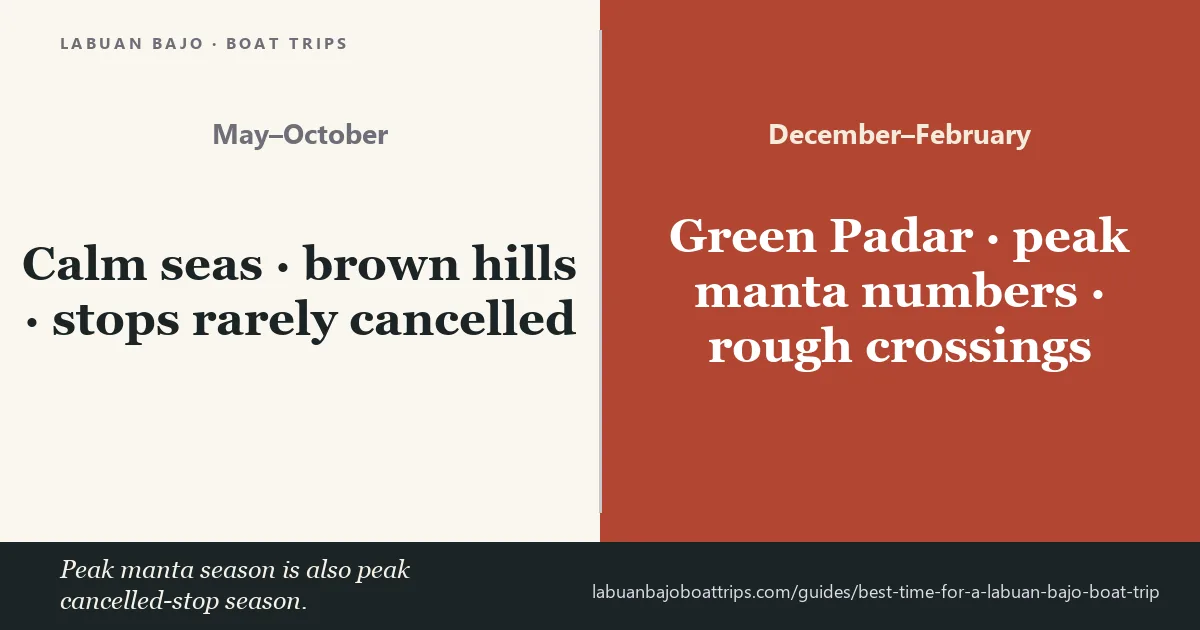
April to October is the dry season: calmer seas on average, clear water, fewer cancelled stops, brown-gold hills. November to March is the wet season: rougher crossings, green hills, and the most manta visits to Manta Point. July and August are the driest months, and also the windiest and the busiest: the southeast trade winds peak then and can make the southern crossings rough even under a blue sky.
April to June is the sweet spot for a first trip: the rains have eased, the hills are turning from green to gold, the full route runs and the peak crowds are still to come. May and June are the safest single picks. If you want Padar green or mantas in numbers, accept a rougher sea. Dragons are there all year.
Best Time to Go to Komodo Island at a Glance
| Your priority | Months to consider | Main trade-off |
|---|---|---|
| Best overall balance | April to June | The tail of the rainy season can still bring showers in April |
| Drier hiking weather | June to September | Strong sun, busier boats and seasonal wind |
| Green island scenery | December to March, some green into April | More rain and disrupted boat plans |
| Golden Padar landscapes | July to November | Hotter, drier trails with little shade |
| Fewer peak-season crowds | April to June or September to November | Avoiding holidays matters as much as choosing a month |
| Komodo dragons | Year-round | Wild sightings and behaviour are never guaranteed |
| Manta rays | Year-round; more at Manta Point roughly December to March | Numbers and sites change with food, currents and conditions |
| A first 3D2N liveaboard | April to June or September to October | The boat and the forecast still matter more than the calendar |
| Lower weather-disruption risk | Broadly April to October | Trade-wind swell can still change routes, especially around August |
These are tendencies, not promises. A calm day can turn up in the rainy season, and a dry-season departure can still meet wind or rough water. Ask your operator about the marine forecast and the captain’s alternative route instead of relying on a monthly label.
The Short Answer: Which Month Is Best?
If you want one recommendation, choose May or June. The landscape often keeps some green, the main park route is widely offered and the holiday pressure is lower than in July and August.
Choose July or August if dry trails and the classic golden islands matter most, but book early and expect more visitors. Choose September or October for dry-season scenery after the European summer holidays. Choose February or March only if you are comfortable with a flexible programme and the chance of weather changes.
There is no single best month for mantas or dragons. Both can be seen all year, and the day itself often matters more than the season:
- Dragons may be more active in the cooler parts of the day.
- Manta activity depends on plankton, currents, cleaning behaviour and conditions at each site.
- The crew can cancel a swim even when mantas are there, if the current is unsafe.
- Rain in Labuan Bajo does not tell you the conditions at every island in the park.
Pick a broad travel window, then a responsible operator, and leave room for the captain to adjust the route.
Understanding Komodo’s seasons
Komodo National Park lies between Flores and Sumbawa in eastern Indonesia. UNESCO describes a dry climate that supports savannah, deciduous monsoon forest and other specialised plants. That dryness gives the park its famous contrast of rugged hills, pale beaches and blue water.
For trip planning the year splits into a drier and a wetter season, with transition months in between. The boundaries move from year to year, and conditions vary across the park.
Broadly drier season: April to October
From roughly April to October, the northwest monsoon has gone. Seas are calmer on average, visibility for snorkelling runs 20 to 30 metres, and stops get cancelled less often. The crossing between Padar and Komodo Island is the exposed leg that makes the biggest difference to how comfortable a day trip is, and it is at its best in the shoulder months either side of the windy peak.
This is when a speedboat is at its best, because a fast hull’s main weakness is a swell. It is also the season when Manta Point is cancelled least often, although research suggests fewer rays use the central sites then than in the wet season.
The hills are brown and gold. That surprises people who booked on the strength of a photograph of green Padar: the classic emerald ridge shot is a wet-season image.
July and August are the driest months of the year (August often sees rain on only a couple of days), and they are also the windiest and the busiest. The southeast trade winds peak, and the southern crossings around Padar and Komodo can turn choppy. School holidays and peak international travel land together. Boats fill, and the Padar viewpoint at nine in the morning in August is a crowd. That is the strongest argument for either an early speedboat or an overnight trip that puts you on the ridge at sunrise.
The dry season has other downsides too: exposed trails get hot and dusty. Dry season does not mean calm sea every day.
Broadly wetter season: November to March
November to March brings the northwest monsoon. Rain is heavier and more frequent, January and February are the wettest months, and the seas can get rough. Showers are often brief and local, but spells of heavy rain, wind or poor visibility affect boat operations.
Two real compensations:
Padar goes green. The hills that are brown in August turn deep green after the rains, roughly December through March. If the emerald version is the photograph you came for, this is when it exists.
The mantas gather. Manta visits to the central sites, Manta Point among them, are higher in the wet-season northwest monsoon, roughly December to March, when larger feeding groups can gather. If seeing a lot of manta rays matters more to you than possibly seeing one, this window is better; see the Manta Point page and our Manta Point guide.
The cost is reliability. Rougher water means more cancelled stops, and Manta Point is the first thing to go: the season with the most rays is also the season you are most likely to be kept out of the water with them. Expect wet, slippery paths, lower visibility at some snorkelling sites after rain runoff, more humidity and less certainty for tight flight connections. Outside the Christmas, New Year and school holiday dates, there are fewer visitors.
Some boats pause for maintenance or run fewer departures in the wetter months. Others keep going when the harbourmaster, operator and captain judge conditions suitable. Never assume every boat or route runs every day.
Transition months
April, May, October and November sit between the two seasons. They can be excellent months because they mix the best of both, but they are also less predictable. They suit travellers who care more about scenery and fewer crowds than about weather certainty, and they suit a flexible plan with at least one spare night in Labuan Bajo.
Month by month
| Months | Sea | Padar | Mantas | Crowds |
|---|---|---|---|---|
| Apr–Jun | Calmer, settling | Turning brown | Building | Moderate |
| Jul–Aug | Trade winds, choppy on southern crossings | Brown-gold | Possible, fewer at Manta Point | Peak |
| Sep–Oct | Easing wind | Brown-gold | Possible | Easing |
| Nov | Turning | Greening | Building | Low |
| Dec–Feb | Rough | Green | Peak numbers | Moderate; festive peak late Dec |
| Mar | Easing | Green | Higher numbers | Low |
The notes below describe common patterns, not a forecast. Conditions change quickly, and the captain’s decision on the day comes before any planned stop.
January: Green Scenery and Maximum Flexibility
January is in the wet season and is one of the two wettest months. The islands can look vividly green, but rain, cloud, wind and swell can affect departures and routes.
It can work for travellers who:
- Have spare days in Labuan Bajo
- Prefer green hills to dry savannah
- Accept that the advertised itinerary may change
- Put safety ahead of completing every stop
It is a weak choice for a one-day-only visit tied to flights: if the boat is cancelled, there may be no second chance. Overnight trips need careful operator choice too, because cabin ventilation, leak protection, tender transfers and safe anchorage matter more in wet weather.
Mantas are possible, as they are all year, and January falls in the window when visits to Manta Point are higher, but visibility and safe access depend on the day.
February: Lush Islands, Rain Risk and Fewer Certainties
February needs the same flexible mindset as January. It can give you quiet viewpoints, green hills and good marine life, but it is not the month for a rigid itinerary built around a long checklist.
Ask operators whether:
- The boat normally runs in February
- Any parts of the route are commonly avoided
- A refund, new date or alternative applies after a weather cancellation
- The boat has covered communal space
- You can arrive at least one day before departure
Book a hotel night after the trip instead of an evening flight. Rain at the harbour is only one factor; wind, wave direction, swell and currents elsewhere in the park affect the final plan.
March: Late Wet Season and Greener Padar Views
March can start wet and settle as the month goes on, although years differ. It is an appealing month if you want a good chance of green Padar before the hills start drying.
More boats are running again, but do not assume every shared liveaboard has restarted or that every advertised stop will be open. Check the operator’s recent departures and the actual boat, not only a generic package page.
March suits photographers who like green slopes and moving clouds. It is a poor fit if rain on a Padar sunrise would ruin your trip.
April: One of the Best Overall Months
April is often one of the best times to go to Komodo Island. Rain eases, the hills still hold some green and more boat schedules run as the dry season sets in.
The month is particularly good for:
- A first one-day Komodo tour
- A 2D1N or 3D2N trip
- Green-to-golden transition photography
- Avoiding the busiest mid-year period
April is still a transition month, so pack a light rain layer and protect your electronics. Easter, Indonesian public holidays and school breaks can push demand up sharply. Check your exact dates against the Indonesian holiday calendar instead of treating the whole month as quiet.
May: Strong All-Round Choice
May is a useful compromise. It usually combines settling weather, green or part-green hills, a wide choice of routes and less pressure than July or August.
It is a good month to combine:
- Padar Island hiking
- A ranger-led dragon walk
- Pink Beach
- Manta Point or another guided snorkelling stop
- One or two nights aboard
Good seasonal odds do not replace safety checks. Confirm life jackets, emergency equipment, passenger capacity, cabin arrangements and cancellation terms before paying. A May departure on a well-run boat beats a perfect month on an unsuitable one.
June: Drying Landscapes and Popular Sailing Conditions
June is the other strong pick. Rain is less frequent, the islands start turning from green to gold, and visitor numbers rise as the mid-year holidays approach.
It suits travellers who want:
- Drier hiking conditions
- Good access to the classic route
- A mix of green and golden scenery
- A multi-day sailing trip before the busiest weeks
Sun becomes a serious issue. Padar and the other island trails have little shade, so hike early and bring water, a hat and secure shoes. The sea can still get choppy as the trade winds build.
July: Dry, Golden and Busy
July is part of the most popular Komodo boat season. The hills are turning golden, rain is unlikely and the widest choice of shared and private trips is on sale.
The costs are crowds and less booking flexibility. Popular cabin types, private charters and well-reviewed boats fill early. Padar’s main viewpoint and the famous snorkelling sites can feel busy when many boats follow the same schedule.
Dry weather does not mean no wind. A captain may reverse the route, shorten a snorkel or pick a more sheltered anchorage. If you get seasick, ask about the boat’s size, where your cabin is and how long the crossings take.
August: Peak Demand and Strong Seasonal Wind
August has the classic dry-savannah scenery many travellers picture when they think of Komodo. It is also one of the busiest months, and the trade winds are at their strongest, which affects boat comfort and the route.
Book early if you need:
- A specific private boat
- A sea-view or quieter cabin
- A Friday shared departure
- Family cabins
- A guide who speaks a particular language
Komodo dragon breeding is often linked to the middle of the year, but mating behaviour does not mean easier sightings. Dragons are wild, may rest away from the trail and should never be approached for a photo.
September: Golden Hills and Post-Peak Potential
September can be an excellent choice after the July–August rush. The hills are dry and golden, and the main sightseeing and snorkelling routes all run.
It suits travellers who prefer:
- Dry trails
- Warm evenings on an open deck
- Golden Padar photography
- Fewer holiday crowds than in August
Heat and sun are still strong, and the vegetation is much drier than in the first half of the year. Egg laying and nesting come later in the dragon’s yearly cycle, but do not expect or look for close nesting encounters. Rangers choose the safe trail and viewing distance.
October: Hot, Dry and Transitional
October usually keeps the dry-season advantages while heading towards the next change of season. Exposed islands can be hot, and the hills are brown or golden.
It works well for a shoulder-season trip if you do not need green scenery. Conditions may start changing late in the month, so keep your expectations flexible.
For snorkelling, do not judge the day by the sky alone: strong current can run in bright weather. A competent guide checks entry and exit points and keeps a tender ready where needed.
November: Changing Weather and Greener Hints
November is a transition month. Some weeks still feel dry; others bring regular showers and changing seas. The first rains slowly bring the hills back to green, although the timing varies.
November can suit travellers who:
- Want to avoid the obvious peak period
- Do not mind mixed weather
- Have spare time around the boat trip
- Are happy for the captain to use alternative sites
Ask for the operator’s wet-weather procedure. A good answer covers route changes, cancellation, how they will contact you, comfort and safety, and does not just promise that the trip always runs.
December: Festive Demand Meets the Wet Season
December combines rising rain with holiday demand. Christmas and New Year dates can sell out even though the weather is less predictable.
If you travel in December:
- Reserve a suitable boat early for festive dates
- Keep your arrival and departure days separate from the boat trip
- Read the cancellation and rescheduling terms closely
- Bring dry bags or waterproof covers
- Expect the route to stay conditional
December can bring green hills and good wildlife, but it is not a quiet bargain month. Holiday dates matter more than the monthly average.
The shoulder months are the value
April to early June and September to October are where most of the trade-offs disappear. You get calmer water, fewer boats than in July and August, prices that have come off peak, and hills that still hold some colour in April and turn green again from November.
If your dates are flexible and you have no strong preference between green hills and calm seas, book a shoulder month. The park is the same, and you see it with fewer boats around you.
Best Time for a Komodo Boat Tour
For a first boat tour, April to June and September to October give the best balance of route access, scenery and demand. July and August are still good if you book early and accept busier sites and the trade winds.
The right season also depends on the format.
One-day speedboat
A day trip is the format most exposed to a tight schedule. It has one operating day and must cover a long distance before returning to Labuan Bajo.
Aim for the more settled months if:
- You have no spare day
- Padar, dragons and manta snorkelling are all priorities
- A fast, active day is hard on you
Even then, weather or current may remove a stop. Our one-day Komodo tour itinerary shows how much fits.
Our pick: the Komodo National Park Full-Day Speedboat Tour (from $94 per person, 4.8/5 from 406 reviews).
2D1N or 3D2N liveaboard
An overnight trip gives the crew more time and sometimes more routing options, but it also leaves you out on the water longer as the weather changes. The boat, the captain and the anchorage plan matter at least as much as the month.
Wet season? Favour more days. A 3D2N liveaboard has two mornings, so a stop lost to weather can be retried; a day trip or a 2D1N has one and no recourse. And favour a wooden hull over a speedboat, because it rides a swell instead of slamming through it.
Dry season, peak months? Favour early. Either a fast boat that reaches Padar before the fleet, or an overnight that is already anchored below it. In July and August, arriving at 06:30 instead of 09:00 gets you two quite different photographs.
For most first-time liveaboard guests, April to June or September to October is an easy starting point. Our 2-day 1-night Komodo tour guide, the 3-day 2-night Komodo itinerary guide and the Komodo liveaboard guide are good reading before you compare cabins.
Our picks: the 2D1N Komodo & Pink Beach Shared Boat Tour (from $183 per person, 4.2/5 from 499 reviews) for one night aboard, or the 3-Day Komodo Sailing Tour (from $339 per person, 4.7/5 from 102 reviews) if you want the second morning.
Private charter
A private charter can change the pace and sometimes the order of stops, but it cannot override safety limits, weather, currents or park access. Its main seasonal advantage is control over departure time and the freedom to pick sheltered or quieter alternatives.
Our pick: the Komodo 2D1N Private Boat: Dragons, Padar & Pink Beach (from $926 per person, 4.2/5 from 34 reviews), with the park fees included.
Any season: take the motion-sickness tablet before you leave the hotel, not when you start to feel it. The crossing between Padar and Komodo Island is exposed year-round, and August’s wind makes the driest month one of the choppier ones.
Best Time to See Komodo Dragons
You can see Komodo dragons throughout the year, with one qualification: sightings are never guaranteed.
The dragons are not a staged attraction. They roam large natural habitats on Komodo and Rinca, and temperature, prey, breeding and each animal’s movements all affect what you see.
Time of day may matter more than month
Dragons are cold-blooded, so temperature shapes their behaviour. Earlier, cooler walks are more comfortable for you and sometimes coincide with more active animals. In the midday heat, dragons and visitors both slow down.
A sunrise walk does not guarantee more dragons. The rangers’ knowledge of where the animals have been lately is more useful than any general rule.
What breeding season means for visitors
The Komodo Survival Program describes a yearly breeding cycle, with mating in the middle of the year and egg laying later. It is interesting biology, but not a promise of dramatic behaviour beside the visitor trails.
In any month:
- Stay with the ranger and group
- Keep the distance the ranger tells you
- Never feed, touch or surround a dragon
- Do not ask a guide to make a dragon move
- Keep children close and follow the ranger’s age and safety guidance
- Accept that a distant, brief sighting is still a real wild encounter
Our Komodo dragon tour guide explains the differences between the ranger visits and the safety rules.
Best Time to See Manta Rays in Komodo
Manta rays are in Komodo National Park year-round. A five-year study reported by the Marine Megafauna Foundation identified more than 1,000 individual reef manta rays in the park and documented how they use its feeding and cleaning sites.
You will hear about a “manta season”. The research behind it shows visits to the central sites, Manta Point among them, are higher in the wet season, roughly December to March, while southern sites see more rays in the dry-season southeast monsoon. Neither pattern is a guarantee: plankton, tide, current, water temperature and cleaning activity all change the day’s encounter. In the drier months mantas are still around, and the water is often easier for less experienced snorkellers.
Safety comes before a sighting
Manta sites can have strong current. A guide may decide that:
- Only confident swimmers should enter
- Guests should drift in one direction and be collected by tender
- The group should use another entry point
- The snorkel should be shortened
- No one should enter the water
Seeing mantas from the boat does not make the site safe to swim. Choose an operator that can say no when it needs to.
If you get in, stay horizontal, do not chase or touch the animals and never block their path. Our Manta Point Komodo guide covers conditions, swimming ability and responsible behaviour.
Best Time for Green or Golden Padar Island
Padar Island has no single colour. Its savannah changes with the rain, which gives you two very different versions of the famous view.
For greener hills
Go roughly December to March, with some green often lasting into April. How green it gets depends on that year’s rainfall timing. The trails may be damp and cloud can hide the sunrise.
For golden hills
Go roughly July to November. The hills get drier and more golden as the dry season goes on. Paths can be dusty, the sun is intense and there is little shade.
For a green-to-gold compromise
April to June can give you a mix, depending on that year’s rain. That is one reason they appeal to first-time visitors.
Colour should not be the only factor. The Padar climb is exposed in every season. Start early, wear secure shoes, carry water and turn back if heat, illness or mobility makes the top viewpoint unsafe. Our Padar Island guide helps you decide how far to climb.
Best Time for Snorkelling and Diving
Komodo’s reefs are shaped by strong currents that bring in nutrient-rich water. That is why the marine life is so rich, and also why month-based advice only goes so far.
For general sightseeing tours, April to October is the usual choice for lower rainfall and the full route. However:
- Clear skies do not guarantee clear water.
- Strong current can run in any month.
- Visibility differs between the northern, central and southern sites.
- A site that suits experienced divers may not suit casual snorkellers.
- Conditions can change between morning and afternoon.
Dive operators shift their focus within the park as the monsoons change which areas are calm. If diving is the main reason for your trip, ask a reputable dive centre which sites suit your certification and travel month. Do not pick a route from social-media clips.
For recreational snorkelling, the number of guests per guide, flotation aids, tender support and a crew willing to choose a sheltered site matter more than the month. Our Komodo snorkelling guide compares the common stops.
When Is Komodo Most Crowded?
July and August are usually the busiest months, because the dry season overlaps with the northern summer holidays. Christmas, New Year, Easter, Indonesian public holidays and school breaks bring short peaks outside those months.
Crowds affect more than the viewpoint. They can change:
- Which good boats and cabins are still free
- Private-charter prices
- Harbour pickup times
- How ranger groups move along the trails
- The number of boats at manta and snorkelling sites
- Hotel prices in Labuan Bajo
May, June, September or October can ease the pressure, but no month is empty. Many boats follow similar routes, so departure time and stop order matter as much as the month.
A private trip lets you set the pace, but you still share the famous sites with other visitors. A responsible operator will not use speed or unsafe timing to “beat the crowds”.
Does Low Season Mean Lower Prices?
Sometimes, but not reliably. Hotels and some operators offer better value outside the busy dates, while crew, fuel, permits and maintenance cost the boats a lot all year.
Shared-trip prices may depend on whether enough passengers book. A low headline price can also mean a simpler boat, deck sleeping, shared bathrooms or excluded fees, not a seasonal discount.
Compare like with like:
- Exact boat and departure date
- Private or shared cabin
- Air-conditioning schedule
- Bathroom arrangement
- Meals and drinking water
- Snorkelling equipment
- Hotel transfers
- Park fees and ranger charges
- Cancellation and weather policy
Do not choose a boat on price and month alone. Safety equipment, a licensed operator and honest communication are worth more than a small seasonal saving.
Best Time for Families and Seasickness-Prone Travellers
Families and travellers who get seasick should look for a settled period, a suitable boat and a realistic itinerary. April to June is a good starting point, but no month guarantees flat water, and the August trade winds make that month one of the choppier ones.
Before booking, ask:
- Which crossings are usually the longest?
- Is there shaded outdoor seating with a view of the horizon?
- Where is the cabin relative to the engine and bow?
- Does the boat carry child-sized life jackets?
- Can a guest skip a difficult snorkel or hike?
- What happens if a child cannot use the tender safely?
- Who makes the final weather decision?
Ask a doctor or pharmacist about motion-sickness medicine, particularly for children, pregnancy or existing conditions. Take it at the advised time, before symptoms start.
A day tour is not automatically gentler: a speedboat can feel harsh in chop. A larger liveaboard moves more slowly but means sleeping aboard. Comfort depends on the boat, the route and you, not only on how long the trip lasts.
How Weather Changes a Komodo Itinerary
The itinerary you book is a plan, and the sea has the final say. A captain may change it because of:
- Wind strength and direction
- Wave height or swell
- Current at a snorkelling site
- Heavy rain or poor visibility
- Tides at beaches and landing points
- Safe anchorage availability
- Harbourmaster instructions
- Park access or ranger operations
A change can mean running the stops in reverse, going to Rinca instead of Komodo, choosing a sheltered snorkelling site or dropping Manta Point. It can be disappointing, but a good operator puts safety first.
Before booking, ask which stops are core and which are conditional, and whether a weather cancellation leads to a refund, a new date, a credit or a partial alternative. Get the answer in writing.
How Far Ahead Should You Book?
How early you book depends on how specific your needs are. Whatever the season, the park permit itself has to be booked two to three days ahead under the 2026 rules; our fees guide explains how.
Book earlier when you need:
- July, August or festive holiday dates
- A private charter
- A particular boat
- A premium cabin
- A family room
- A weekend shared departure
- A specialist guide or dive route
Several months ahead is sensible for popular boats. Do not pay in full just because a seller says only one place is left; check the company, the boat and the terms first.
You may have more flexibility when:
- Travelling in a shoulder month
- Happy with several suitable boats
- Choosing a one-day shared trip
- Staying extra days in Labuan Bajo
Booking late lets you see the latest forecast, but you get less choice of boat. A good compromise is to reserve a verified operator with clear weather terms, then confirm the details close to departure.
Build Weather Flexibility into Your Flights
Do not fly into Labuan Bajo on the morning of a boat departure. A delayed flight, lost bag or schedule change can make you miss boarding, and shared boats may not wait.
Arrive at least one day before the tour. After a multi-day trip, stay in Labuan Bajo on the night you return as well: boats can reach the harbour later than advertised because of sea state, route changes or port traffic, and Komodo Airport’s departures are mostly early to mid-afternoon.
The safer pattern is:
- Fly to Labuan Bajo.
- Stay overnight and attend any operator briefing.
- Do the boat trip.
- Stay another night in town.
- Fly onward the next day.
The buffer matters most from December to March, but it helps all year.
What to Pack in Each Season
The core list barely changes through the year: sun protection, secure shoes, a reusable water bottle, swimwear, a dry bag and personal medication. Our Komodo packing list has the full version.
For the wetter months
Add:
- Lightweight rain jacket
- Waterproof phone and document protection
- Quick-drying clothes
- Spare dry clothes in a sealed bag
- Shoes with grip for wet steps and trails
- Mosquito repellent
Leave heavy luggage behind; it is hard to move through a wet tender transfer.
For the drier months
Prioritise:
- High-protection sunscreen
- Hat with a secure strap
- Sunglasses
- Light long sleeves
- Electrolytes if medically suitable
- Scarf or light layer for wind on deck
Dry-season mornings and windy crossings can feel cooler than the midday hike.
For any month
Bring reef-safe toiletries and never take coral, shells, sand or wildlife. Use the boat’s waste system and avoid single-use plastic where you can.
How to Choose Your Best Month
Start with the one thing you will not compromise on.
Choose April to June if:
- You want the best general compromise
- Green scenery matters
- You are planning your first liveaboard
- You prefer to avoid the busiest mid-year weeks
Choose July or August if:
- Dry, golden landscapes are your priority
- You can book early
- You accept crowds and the trade winds
- You want the widest choice of scheduled trips
Choose September or October if:
- Golden scenery appeals to you
- You prefer to travel after the summer peak
- You are comfortable with heat and dry trails
Choose November to March if:
- You value lush landscapes and fewer visitors outside the holidays
- You can tolerate rain and route changes
- You have spare days around the trip
- You choose a boat set up for wet weather
Then apply three filters: the latest forecast, the operator’s reliability and your own comfort. They will help you more than hunting for a flawless date a year in advance.
Frequently Asked Questions
What is the best month to visit Komodo National Park?
May or June for most travellers. They combine settling weather, a wide choice of boats, some green left on the hills and lower demand than July or August. Years differ, so check the marine forecast close to departure.
What is the best time to go to Komodo Island for good weather?
The drier season from April to October. July and August are the driest but also windy and busy. April to June and September to October balance weather and crowds best.
Can I visit Komodo National Park in the rainy season?
Yes, boats run in the wetter months when conditions and official instructions allow. Rain, choppy water, route changes and cancellations are all more likely, so build spare days into your plans and check the boat’s weather policy.
When is the best time to see Komodo dragons?
Dragons live in the park all year. Cooler morning walks sometimes coincide with more activity, but no month or time of day guarantees a sighting. Always follow the ranger.
What is Komodo dragon mating season?
Conservation sources place mating in the middle of the year, with egg laying later. That does not mean you will see mating behaviour, and guides should never disturb the animals to create an encounter.
When is manta season in Komodo?
Reef manta rays are in the park all year. Visits to Manta Point and the other central sites are higher in the wet season, roughly December to March, while the southern sites see more in the dry season. No month guarantees a sighting.
Is July or August too crowded?
Not necessarily, but both are high-demand months. Book a reputable boat early and expect other groups at Padar, the ranger stations and the famous snorkelling sites. A flexible stop order helps, though it will not remove the crowds.
When is Padar Island green?
Padar is greenest during and just after the wet season, roughly December to March, with some green often lasting into April. The exact timing depends on the rain. From mid-year the hills turn golden and dry.
What month has the calmest sea in Komodo?
No month guarantees calm water. Rain, wind, swell and current are separate things, and they differ across the park. The dry season is calmer on average, but the trade winds peak around August; April to June and September to October usually give the best balance. The forecast and the captain’s judgement should decide the route.
Is the dry season best for Manta Point?
Not automatically. Mantas are there all year, and the central sites see more of them in the wet season. The dry season means Manta Point is cancelled less often, but a dry day can still have strong current, and a guide may cancel the swim even when mantas are visible.
Should I book a day trip or liveaboard for uncertain weather?
A liveaboard gives you more time and sometimes a second try at a stop, but you spend the night out on the water. A day tour avoids sleeping aboard but has only one chance at the route. Choose by your comfort, your spare time and the specific boat’s standards.
Can a tour guarantee Komodo dragons and manta rays?
No responsible operator can guarantee wild animals. The tour visits their habitat when access and conditions allow; sightings and behaviour stay unpredictable.
Do park fees change by season?
Fees depend on visitor category, activity, day and current regulations, not on wet or dry season. Ask the operator for an itemised quote and check the current park fees before you travel.
Final Recommendation
For most first-time visitors, April to June is the best time to visit Komodo National Park. It gives you a strong chance of workable boat conditions, varied scenery and more room than the busiest months. May and June are the most practical all-round choices.
No month is bad in absolute terms. July and August suit travellers who want dry, golden landscapes; September and October are excellent shoulder months; and the wet season suits flexible visitors, who get green islands and more mantas at the central sites.
Pick the month that matches your priorities, then control what you can: a suitable boat, a responsible operator, realistic wildlife expectations and spare time around the trip. Check the marine forecast and official access information shortly before departure, because the safest route depends on conditions on the day.
Ready to pick? The guide to choosing puts every format side by side, and our complete Komodo National Park boat trip guide covers the wider planning.
Sources and Further Reading
- UNESCO World Heritage Centre: Komodo National Park: park landscape, climate, biodiversity and conservation context
- Marine Megafauna Foundation: Komodo National Park manta ray study: year-round reef manta presence and site use
- PeerJ: Residency, movement patterns, behaviour and demographics of reef manta rays in Komodo National Park: the peer-reviewed manta research
- Komodo Survival Program: Komodo dragon reproduction and life-cycle information
- Official Komodo National Park website: current park information and visitor notices
Seasonal patterns are indicative and vary from year to year. Park access, fees, routes and operating rules may change; confirm current details with the authorities and your operator before departure.
One Long Day, Eight Stops, No Roads
The full-day Komodo boat trip is what most Labuan Bajo visitors actually book — Padar at sunrise, Pink Beach, the ranger walk on Komodo Island and Manta Point, back before dark. Free cancellation up to 24 hours ahead.
Check Availability & Book